

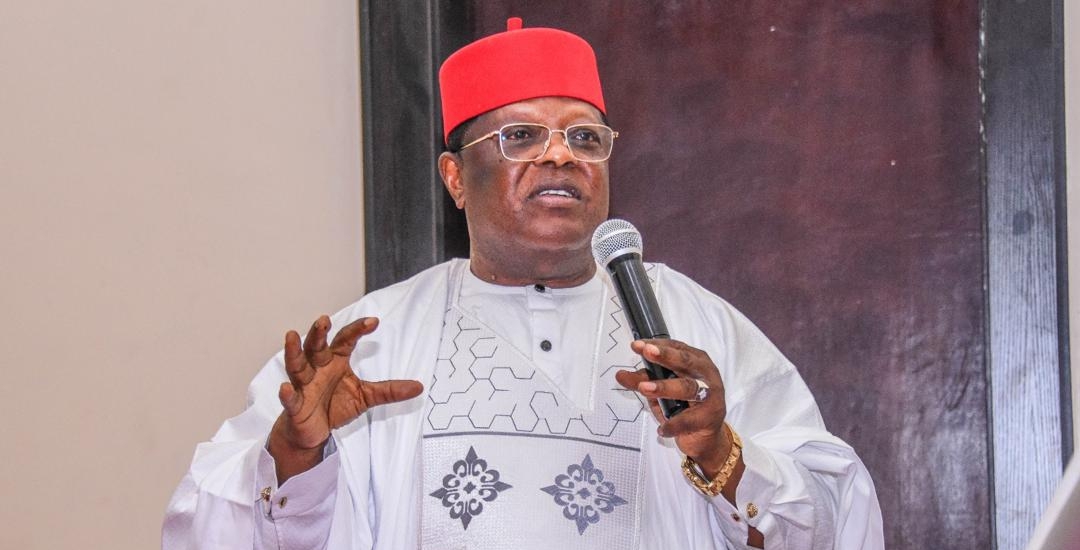
Francis Nwaze, Senior Special Assistant to the Minister of Works on Media, has defended David Umahi’s record in public office while questioning Peter Obi’s contribution to Ebonyi State and the wider Southeast.

In a statement responding to an article by Valentine Obienyem titled “Dave Umahi and Incestuous Reasoning,” Nwaze accused Obi’s supporters of applying a “selective” standard when comparing the two politicians.
He argued that while Obi was praised as a model leader, critics failed to provide evidence of what he delivered for Ebonyians or the broader Igbo community.
Nwaze said the central question was what Obi had done for Ebonyi and the Southeast that made him the benchmark against which Umahi should be judged.
He also attributed Obi’s rise in national politics partly to the circumstances surrounding the 2020 #EndSARS protests, describing his emergence as an “accident” of the period.
The statement criticised supporters of Obi, popularly known as Obidients, for allegedly attacking opponents and branding critics as enemies.
Nwaze said comments defending the group against accusations of attacking political opponents amounted to an acknowledgement that such attacks occurred.
He also clarified remarks attributed to Umahi that Ebonyi State would not vote for Obi because he could not win there. According to Nwaze, the comment was directed specifically at Ebonyians and did not amount to excluding the state from the Southeast.
Nwaze linked the remarks to what he described as the treatment of Ebonyians living in Anambra during Obi’s tenure as governor.
He cited alleged discrimination against Ebonyians and Obi’s silence during disputes, including the renaming of Abakaliki Street. These claims were presented in the statement but were not independently substantiated.
A significant part of Nwaze’s argument focused on political appointments. He challenged Obienyem to identify Ebonyians who held substantive positions in Anambra during Obi’s administration, arguing that mentioning Obi’s Ebonyi-born security personnel was insufficient.
By contrast, Nwaze listed several Anambra indigenes who, he said, served in Umahi’s Ebonyi administration. They included Charles Emeka Akpuenika, who served as commissioner for youths and sports; Rose Ezeadikwa of the State Universal Basic Education Board; Chinaco Nzeakor, a special assistant on internal security; Reverend Euphraim Ononye, chairman of the Ebonyi State Pilgrims Board; and Uchem Oka, a technical assistant to the governor.
Nwaze further defended Umahi’s infrastructure record as governor of Ebonyi State. He cited the construction of 14 twin flyovers, concrete roads across the state, the David Umahi Federal University of Health Sciences, an airport, and the Ebonyi State International Shopping Mall.
He said the flyovers, which reportedly cost between ₦1.8 billion and ₦2.5 billion each when constructed, would cost considerably more if rebuilt at current prices.
Nwaze attributed the relatively low costs to the use of direct labour, describing the projects as evidence of Umahi’s approach to delivering infrastructure with limited resources.
The minister’s aide also highlighted Umahi’s role in federal infrastructure projects under President Bola Ahmed Tinubu.
He pointed to work on the Enugu–Onitsha Road, the Enugu–Port Harcourt Road, the Eke-Obinagu Flyover, access roads to the Second Niger Bridge, the First Niger Bridge, and the proposed Calabar–Ebonyi–Enugu–Benue–Nasarawa–Abuja Superhighway.
According to Nwaze, the projects demonstrate the Federal Government’s effort to improve connectivity between the Southeast and other parts of the country.
He also mentioned solar lighting, tree planting, reinforced concrete pavement and CCTV infrastructure along parts of the Enugu–Onitsha corridor.
Nwaze argued that these projects represented tangible results that should be weighed against what he described as Obi’s less visible record.
He questioned why voters in the Southeast should abandon ongoing infrastructure projects for political promises and achievements that, in his view, were yet to be demonstrated on a comparable regional scale.
The statement contrasted Umahi’s career across several levels of public service with Obi’s principal elected experience as governor of Anambra State.
Umahi has served as deputy governor and governor of Ebonyi State, chairman of the Southeast Governors’ Forum, senator for Ebonyi South and minister of works.
Nwaze also rejected references to Umahi’s family and the death of Mary Habila as irrelevant to the substantive debate over the minister’s record. He urged that Habila’s death and reported health condition should not be used as political material.
The statement concluded with a call for Ebonyi voters to support Tinubu through Umahi, arguing that the state had moved beyond what Nwaze described as the limitations of Obi’s political record.
The claims and comparisons contained in the statement reflect the position of Umahi’s media office and form part of the wider political contest ahead of the 2027 elections.