

The spillover of the ongoing U.S.-Iran conflict has officially breached the African continent, prompting a swift and resolute response from the African Union (AU).
Just days after a drone strike sparked fires aboard two major energy vessels at Egypt’s Mediterranean Port of Damietta, the AU has issued a forceful condemnation, framing the attack not merely as a regional skirmish, but as a direct violation of African sovereignty.
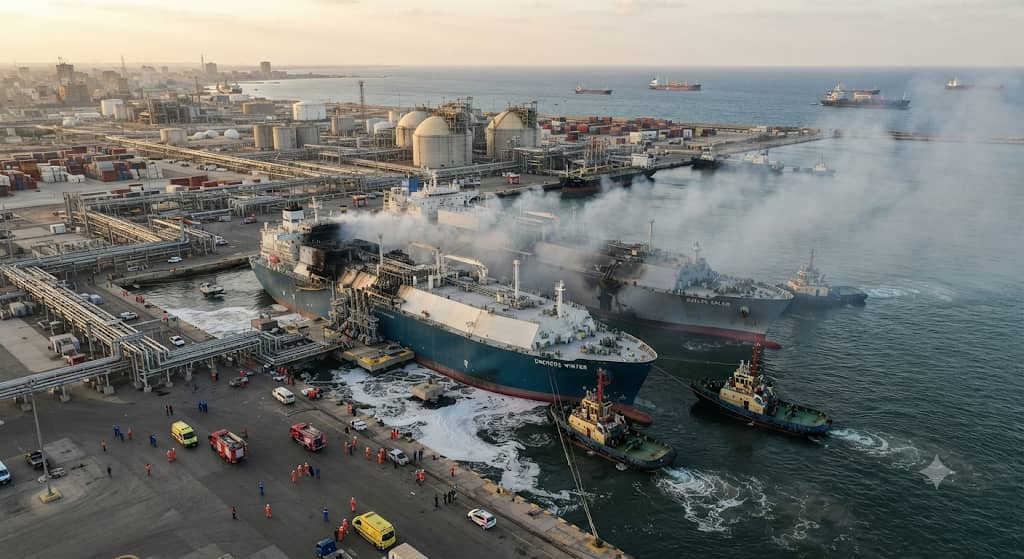
The July 29 incident saw an unidentified drone strike the Energos Winter, a U.S.- owned floating storage and regasification unit, with the blaze quickly spreading to a Greek-owned tanker, the GasLog Salem.
While Egyptian authorities successfully extinguished the flames without any loss of life, the attack sent shockwaves across the continent.
Damietta is a critical hub for liquefied natural gas (LNG) exports, situated near the highly sensitive Suez Canal.
For Mahmoud Ali Youssouf, Chairperson of the African Union Commission, the strike represents a dangerous precedent.
In a statement released on Thursday, the AU Commission Chairperson drew a clear boundary regarding foreign conflicts impacting the continent.
“Africa must not become a theatre for the spillover of conflicts originating beyond the continent, nor should its critical civilian infrastructure be exposed to such threats,” Youssouf declared.
The Chairperson’s remarks underscored that Egypt’s national security is inextricably linked to the stability of the broader continent.
By framing the attack as a breach of an AU member state’s territorial integrity, Addis Ababa is signaling a unified continental stance against external proxy wars disrupting African trade and energy hubs.
The AU reaffirmed its unwavering commitment to international law and the safety of maritime navigation— principle pillars for a continent heavily reliant on global shipping routes.
Solidarity with Cairo was immediate and broad. Sudan, for example, issued a statement through its Ministry of Foreign Affairs condemning the strike as a “hostile act” that threatens regional stability.
Somalia, too, denounced the attack, warning of the dangers to freedom of navigation.
The Damietta strike is the latest flashpoint in a rapidly expanding Middle Eastern conflict.
It occurred hours after the U.S. and Saudi Arabia launched joint airstrikes on Iran-backed militias in Iraq, and amid an escalating Houthi blockade of Saudi vessels in the Red Sea.
With the Strait of Hormuz under threat, attacks have now stretched westward into the Mediterranean, directly targeting a nation that has played a crucial mediating role in the crisis.
Egyptian officials have signaled a restrained, diplomatic response, prioritizing regional stability over retaliation.
However, the AU’s vocal intervention adds a significant diplomatic weight to the situation.
As global powers maneuver in the region, the African Union has made it clear: the battles of the Middle East will not be fought on African soil.