

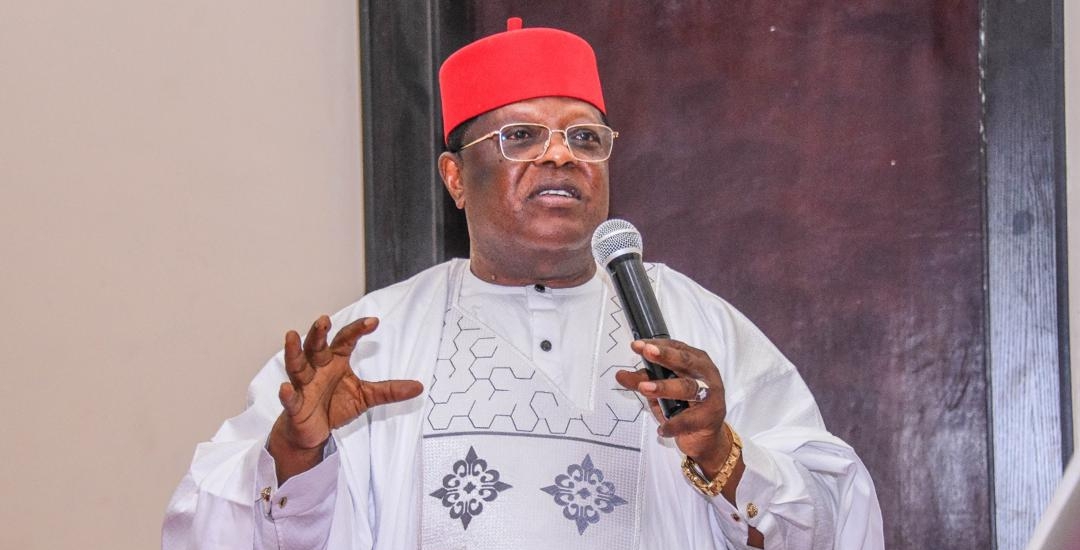
The Federal Government has reclaimed the 136-kilometre Benin–Asaba Road and ordered its complete redesign and reconstruction as a dual carriageway, Works Minister David Umahi has announced.

Umahi made the disclosure on Thursday, October 15, 2026, during the reopening of the First Niger Bridge on the Asaba– Onitsha Road.
He said President Bola Ahmed Tinubu had directed the Ministry of Works to take full responsibility for the troubled highway, ending the concession arrangement that had previously restricted government intervention.
“The legacy of President Bola Tinubu, you will see it ongoing on this road. Never again will our people suffer on this road,” Umahi said.
He added that emergency repairs were already underway on critical sections, with permanent reinforced-concrete pavement works expected to begin once the redesign was completed.
The announcement came alongside the reopening of the First Niger Bridge, a vital link between the South-East and South-South.
The bridge, commissioned in 1966, recently underwent major rehabilitation after an inspection uncovered the removal of bolts and the cutting of steel components—acts the minister warned could have compromised its structural integrity.
The rehabilitation included asphalt resurfacing, median demarcation, improved security measures and the installation of CCTV cameras, solar lighting and monitoring centres at both ends of the bridge.
Three turnaround passages were also created to help motorists manage breakdowns safely.
Umahi warned against illegal sand dredging within 10 kilometres of bridges, directing officials in Delta and Anambra states to ensure the regulation was enforced.
He further announced plans to reconstruct about 400 kilometres of the East-West Road, alongside continued work on the Lagos–Calabar Coastal Highway, the Enugu–Port Harcourt corridor and the Second Niger Bridge bypass.
According to the minister, the projects form part of the Tinubu administration’s broader infrastructure programme for the South-East, South-South and Niger Delta.
He said the government’s use of reinforced concrete was intended to deliver roads capable of serving Nigerians for decades.