

The United States has announced an additional $11 million in humanitarian assistance for Colombia after a powerful earthquake struck the country’s west, bringing Washington’s announced earthquake-related support to $26.5 million**.
The magnitude-7.4 earthquake struck near San José del Palmar in Chocó Department on Aug. 10 at an estimated depth of about 100 to 110 kilometres.
The tremor was felt across at least nine departments and in parts of neighbouring Ecuador and Panama.
The Colombian Geological Service described it as the strongest earthquake recorded in the country during the 21st century, according to independent reporting.
The disaster has affected a wide area. The latest situation update from the U.N. Office for the Coordination of Humanitarian Affairs, based on reports available on Aug. 14, said the earthquake and its effects had reached 15 departments and 437 municipalities, affecting at least 135,179 people.
The update also recorded 183 aftershocks in the five days following the main shock.
The human toll remains subject to revision as rescue teams reach isolated communities and authorities reconcile local and national figures.
An earlier humanitarian assessment reported 239 deaths, 3,755 injuries and 496 missing people as of Aug. 13, while other contemporaneous reports carried different totals.
The variation reflects the speed of the emergency, difficult access to rural areas, communications outages and ongoing identification of victims. The figures should therefore be treated as provisional rather than final.
Damage stretches from cities to remote communities
The earthquake caused severe damage in parts of western Colombia, including Cali, Pereira, Manizales and Quibdó.
The Aug. 13 humanitarian assessment recorded 45,457 damaged homes, 9,215 destroyed homes and 140 collapsed buildings. It also said that 7 hospitals had been evacuated and 188 health facilities were affected.
The impact has been especially difficult to assess in Chocó, a largely rural and mountainous region that includes Afro-Colombian and Indigenous communities.
Humanitarian agencies reported that some municipalities lacked reliable electricity, telecommunications or road access, while 13 municipalities had not submitted damage data by the time of the assessment.
The absence of information does not necessarily indicate limited damage; it may instead reflect the difficulty of reaching affected populations.
Access problems have complicated the response. Airports in Quibdó and Buenaventura reopened after temporary closures, but the road to Buenaventura remained blocked by approximately 20 landslides, and the airports could not operate at night.
Humanitarian agencies also warned that armed-group activity and landmine contamination in some areas create additional risks for responders and residents.
The crisis is unfolding in communities that already faced poverty, infrastructure shortages and humanitarian pressures.
Those pre-existing vulnerabilities may increase the earthquake’s effects, particularly where homes are fragile, health services are limited and residents have few alternatives for shelter or income.
In Buenaventura, for example, aid agencies identified water and sanitation needs against the backdrop of an existing water crisis.
Search, shelter and health needs remain urgent
Humanitarian agencies identified search and rescue, debris removal and emergency medical care as immediate priorities.
The response also requires trauma and surgical supplies, blood products, additional hospital capacity, temporary shelter, blankets, tents, generators, safe drinking water, food and hygiene materials.
The need for shelter is significant because thousands of homes have been destroyed or rendered unsafe. Many residents have been sleeping outdoors because of structural damage and continuing aftershocks.
The U.N. assessment said authorities had identified more than 49,000 affected people through family-level records, although there was no consolidated national displacement figure at that stage.
The earthquake also disrupted essential services, including electricity, water, health care, communications and education.
Schools were suspended in numerous locations, while hospitals and clinics in affected areas faced both physical damage and increased demand. Humanitarian agencies have continued rapid assessments to determine which communities require the greatest support.
U.S. expands funding and logistical support
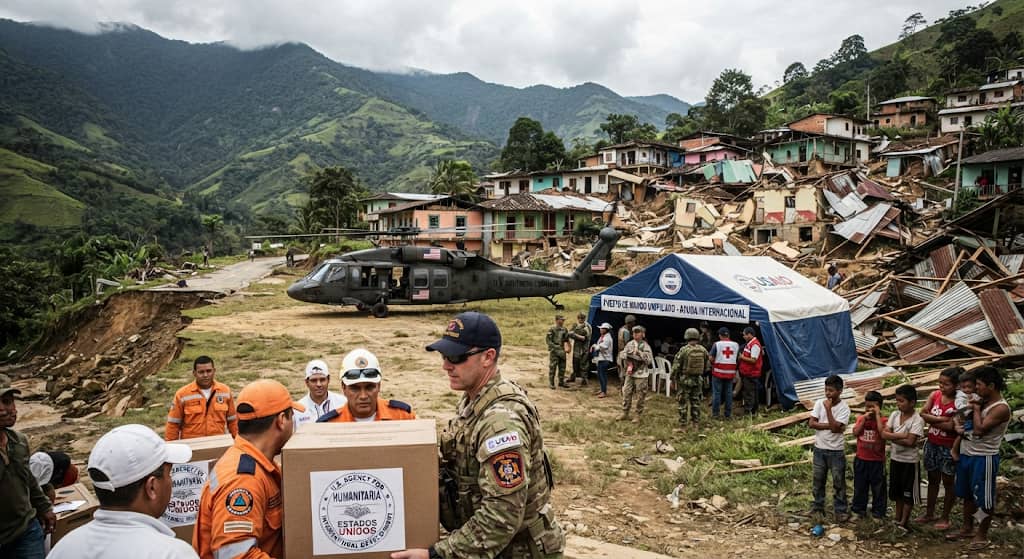
The U.S. State Department said the new $11 million will support food, health, protection and shelter programs, as well as structural assessments through partners including Catholic Relief Services, the International Federation of Red Cross and Red Crescent Societies, the International Organization for Migration, Miyamoto International, UNICEF, the U.N. World Food Programme and World Vision.
The department said the initial U.S. commitment announced on Aug. 11 was $15.5 million. Of that amount, $3 million provided through Catholic Relief Services comes from a previously announced global assistance award.
Washington also cited its contribution to the U.N. Office for the Coordination of Humanitarian Affairs, including $200 million assigned to the Colombia Pooled Fund.
That pooled funding can be used for earthquake-related needs as well as pre-existing humanitarian needs, meaning the entire amount is not necessarily dedicated to this disaster.[5]
The United States is also using logistical support from U.S. Southern Command to move relief supplies from a State Department warehouse in Miami to Colombia.
The planned shipments include shelter materials and water, sanitation and hygiene supplies.
Hundreds of Starlink satellite-internet kits are also expected to be delivered to help humanitarian organizations and Colombian authorities maintain communications during relief operations.
Two urban search-and-rescue technical support teams from the fire departments of Fairfax County, Virginia, and Los Angeles County, California, arrived in Colombia on Aug. 12.
They are providing coordination, communications and structural- engineering support to Colombian-led rescue operations.
Response faces major coordination and access challenges
Colombia’s government has declared a national disaster and is coordinating the response with local authorities, the Colombian Red Cross, civil-defence teams, military units and international agencies.
The U.N. humanitarian system said an initial $5 million allocation from the Central Emergency Response Fund was being directed toward life-saving operations, particularly in hard-to-reach rural areas.
The scale of the disaster means that financial assistance alone will not determine the speed of recovery.
Relief agencies must still reach isolated communities, verify damage, prevent duplication among aid providers and restore basic services.
The authorities also face the challenge of moving from emergency rescue to temporary housing, health recovery and reconstruction while aftershocks and unstable structures continue to pose risks.
The State Department said it is coordinating with President Abelardo de la Espriella and the Colombian govt and is providing consular assistance to U.S. citizens in affected areas.
Americans in Colombia have been advised to enrol in the Smart Traveler Enrollment Program and monitor updates from the U.S. Embassy in Bogotá.
The casualty and damage figures in this report are provisional and come from assessments issued at different times.
The latest U.N.-linked update cited here was based on official reports available through Aug. 14, while the U.S. funding announcement was issued Aug. 14.
Further revisions are likely as search operations continue and previously inaccessible communities are assessed.