

The European Union has expressed deep concern over a deadly surge in violence in the occupied West Bank following the clashes on Friday, July 24, 2026, that left six people dead.
The incident in the northern village of Tal, near Nablus, has triggered widespread international condemnation and a severe Israeli military crackdown, highlighting the fragile and volatile nature of the situation in the region.
In a statement released, a spokesperson for the European Union voiced its “deep concern” regarding the escalation.
“We express our deepest condolences to the families of those killed, and wish those injured a full and speedy recovery,” the statement read. “Today’s events are a reminder of the fragility of the situation on the ground.
The European Union urges all parties to avoid inflammatory language, contribute to deescalation, and put an end to the vicious cycle of violence”.
The violence erupted in the early morning hours in the village of Tal (also referred to as Tell), located in Area B of the West Bank, which falls under joint Israeli- Palestinian Authority security control.
Accounts of the incident remain deeply contested between Israeli and
Palestinian sources.
According to the Israel Defense Forces (IDF), soldiers responded to reports that Israeli civilians hiking in the area had been attacked.
The military stated that a security guard from a nearby settlement outpost arrived at the scene but had his weapon stolen by a Palestinian resident.
The IDF alleges that the Palestinian then opened fire on the Israelis, while killing Benyahu Mellet, 32, before being killed by soldiers.
The military further reported that the
death of a 27-year-old soldier, Maj. Yuval Ezra, occurred during the subsequent operational activity, along with three other Palestinians from the same family who were killed in an “exchange of fire”.
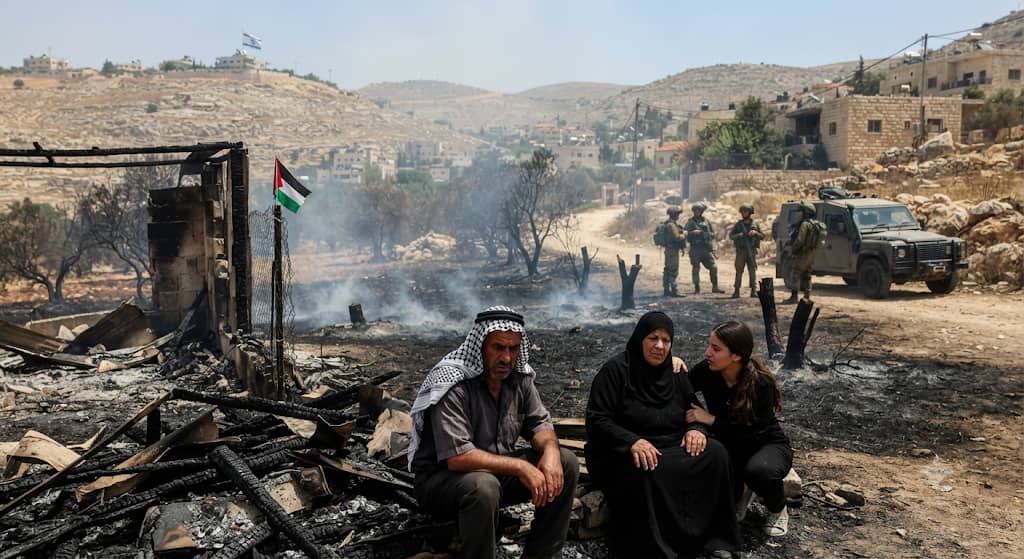
Palestinian accounts, however, paint a drastically different picture. Eyewitnesses and local officials state that the violence began when a large group of approximately 20 to 50 armed Israeli settlers descended upon the village.
They alleged that the settlers attacked Palestinian homes and set fire to the agricultural land before a physical confrontation broke out with residents.
Witnesses claim that Israeli soldiers stood by without intervening as the settlers initiated the attack.
A subsequent chaotic scene unfolded where, according to Palestinian reports, soldiers fired upon the villagers.
The aftermath of the deadly confrontation has been swift and severe. Israeli Prime Minister Benjamin Netanyahu ordered an “intensive counter terrorism operation,” resulting in the deployment of five additional military battalions to the West Bank.
The Israeli govt has also announced plans to demolish the home of the alleged Palestinian gunman, conduct vigorous military operations in villages suspected of harboring militants, and accelerate the legalization of unauthorized settler outposts.
Far-right Israeli politicians have escalated the rhetoric further. Finance Minister Bezalel Smotrich and National Security Minister Itamar Ben-Gvir have publicly called for the destruction of Palestinian villages, comparing the necessary response to the military actions taken in Gaza.
Human rights organizations have warned that the situation is reaching a critical tipping point. The Human Rights Watch (HRW) issued stark warning on the same day, stating that the surge in settler violence threatens “mass atrocities.”
HRW noted that years of lawlessness
and impunity for settler attacks have turned the West Bank into a “powder keg waiting to explode”.
The deadly incident is part of a broader, alarming trend of violence in the West Bank since the outbreak of the Gaza war in October 2023.
According to the United Nations Office for the Coordination of Humanitarian Affairs (OCHA), settler attacks have become a leading cause of Palestinian injuries in 2026, accounting for 55 percent of all such incidents.
In 2026 alone, the Palestinian Health Ministry reports that 87 Palestinians have been killed in occupied territories, including 21 by Israeli settlers, while over 3,200 Palestinians have been displaced by settler attacks and demolitions.
The EU’s statement comes amid ongoing diplomatic efforts to curb settlement expansion and violence.
In May 2026, the European Union agreed to implement new sanctions targeting Israeli settlers due to the escalating aggression.
However, the bloc remains divided on broader measures, having recently failed to approve a motion to impose trade sanctions on products from illegal settlements.
As the Israeli military continues its widespread deployment and counter terrorism operations across the northern West Bank, fears of further reprisal attacks remain high.
The international community now faces the urgent challenge of preventing the cycle of violence from spiraling further out of control.