

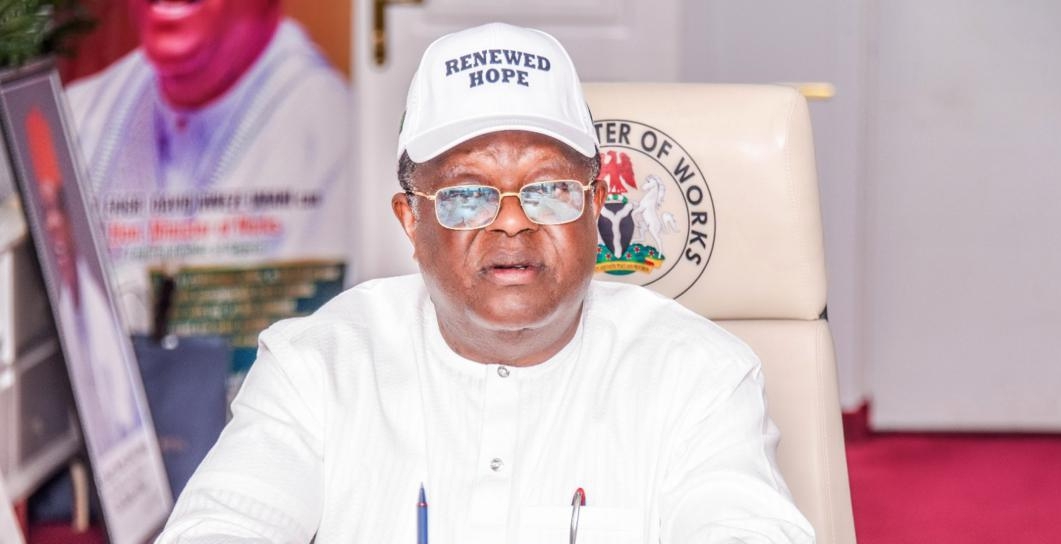
In a decisive move that signals the end of “business as usual” in the Nigeria’s infrastructure sector, the Minister of Works, David Umahi, has announced a rigorous “weeding out” process for the contractors who fail to prioritize national progress.
Speaking during a high-stakes inspection of the Mararaba-Keffi Road on Saturday, Umahi made it clear that the era of collecting mobilization fees only to disappear or demand variations is over.
“From next week, we are going to weed out whether you are an indigenous contractor or you are an expatriate,” the Minister declared.
“Once you are not ready to invest… you are not part and parcel of love and progress for this country. We are going to weed out those contractors who only wait until they have advance payment before they can work.”
The Minister’s warning serves as a stern ultimatum to what he described as “funny contractors”—firms that have benefited from the country for decades but lack the commitment to work through funding challenges.
Umahi emphasized that nation-building
is a collective responsibility, and his ministry will no longer tolerate delays that stall the President’s vision for a connected Nigeria.
A Benchmark for Indigenous Excellence
Amidst the crackdown, the Minister held up JRB, an indigenous firm, as the gold standard for local capacity.
Describing them as the “best indigenous contractor,” the Minister praised their willingness to begin work on the 40- kilometer Mararaba-Keffi stretch without immediate payment, already achieving 21 kilometers on binder in just eight months.
This sentiment was echoed by key legislative leaders present at the inspection.
Akintola Alabi, Chairman of the House Committee on Works, commended JRB for proving that “we can do it in Nigeria,” noting that the company’s commitment goes beyond profit.
Similarly, Allwell Onyesoh, Chairman of the Senate Committee on Works, labeled JRB as a “mascot for indigenous contractors,” whose success would pave the way for more local firms to compete internationally and bring in hard currency.
Security and Innovation: The Pilot Scheme
The Minister’s vision extends beyond mere asphalt while revealing that the Mararaba-Keffi project would serve as a presidential pilot scheme for integrated road security.
The plan includes:
• Wireless CCTV Surveillance: Partnering with major networks like MTN and Airtel to ensure real-time monitoring.
• Solar-Powered Lighting: Illuminating highways to deter crime and improve safety.
• Rapid Response Teams: Reviving highway security departments in collaboration with the Inspector General of Police, aiming for a response time of less than 10 minutes.
Internal Accountability: “I Will Sack the Directors”
Umahi’s “weed out” policy is not limited to external contractors; it extends deep into the Ministry of Works itself.
He issued a blistering warning to his own staff, stating that any director, controller who fails to enforce his directives would be removed.
“When I give my directive and I come back and it’s not done, I will move out the directors and controller from the work,” Umahi warned.
“If I give a directive to move this nation
forward and the staff are not doing it, I will remove them entirely from the Ministry of Works.”
Local Support and the Road Ahead
The Minister’s hardline approach has found strong support among local representatives.
Senator Jeremiah Omoru, representing Akwanga, Nasarawa, expressed the deep gratitude of his constituents for the Akwanga-Bauchi-Gombe Road and pledged political support for the administration’s infrastructure-first agenda.
As the Ministry prepares to conserve funds for productive sections of work—prioritizing pothole repairs and pavement longevity over unnecessary removals—the message is clear:
Nigeria’s roads are no longer just a site for construction, but a battleground for
accountability, security, and the national pride. Under Umahi’s watch, only those who “partner in progress” will remain on the field.