

Ethiopia’s fragile post-war calm is
under severe strain after Tigrayan forces reportedly took control of airports in Mekelle, Axum and Shire, while fighting spread into neighboring Afar and Amhara regions and a new coalition of armed groups threatened the federal government.
The African Union and the United Nations have called for an immediate halt to actions that could reignite a wider conflict.

Their warnings came after Ethiopian Airlines suspended flights to the three northern airports and both sides issued sharply conflicting accounts of who initiated the latest escalation.
The crisis marks the most serious challenge yet to the Pretoria Agreement, the November 2022 accord that ended Ethiopia’s two-year Tigray war.
That conflict killed hundreds of
thousands of people and displaced roughly one million, according to estimates and reporting cited by international organizations and news agencies.
The new confrontation is unfolding before the region has recovered from that devastation.
Airports seized, flights suspended
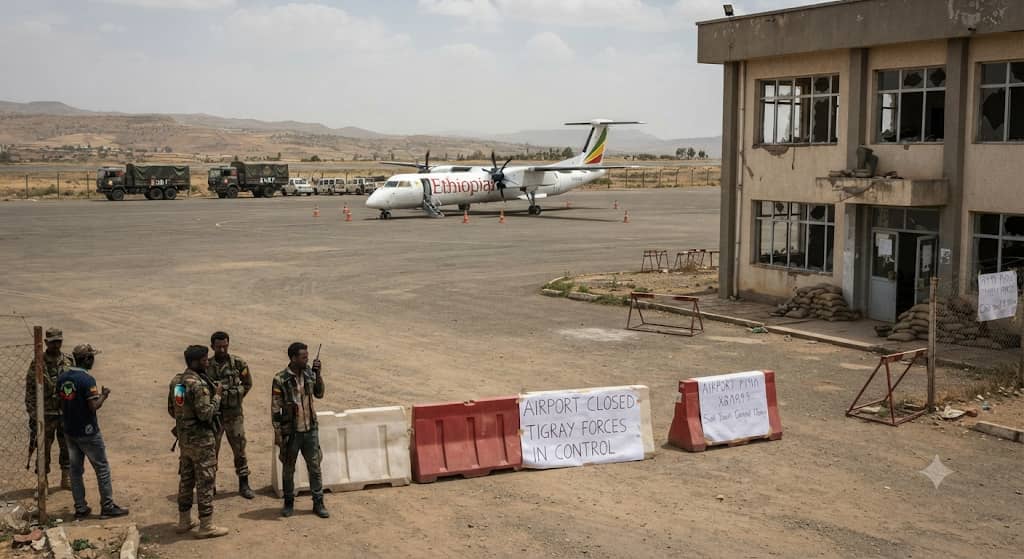
The African Union Commission said Tigray forces had seized and occupied the civilian airports in Mekelle, Axum and Shire. It also cited reports that federal personnel had been detained and said the takeover had disrupted civilian air services.
The United Nations repeated the airport claim in a statement issued on 23 September, describing the situation in northern Ethiopia as “rapidly deteriorating.”
UN Secretary-General António Guterres said fighting had intensified in and around Tigray and was spreading into neighboring areas.
The reported takeover was followed by Ethiopian Airlines’ suspension of flights to Mekelle, Axum and Shire “due to the current situation.” The carrier did not provide additional details.
The disruption is significant because air travel is a crucial link between Tigray and the federal capital, Addis Ababa, particularly when insecurity makes
road transport unreliable.
Accounts from the ground indicated that the airport takeover in Mekelle may initially have occurred without major fighting at the facility.
The Associated Press quoted a taxi driver who said armed Tigrayan fighters ordered him to leave and told workers that no flights would land. The driver said he heard no gunfire around the airport.
An AFP report carried by Asharq Al-Awsat said an airport employee was sent home after being told that Tigray
forces had taken control, while a foreign security source confirmed the information.
The status of federal personnel reportedly detained at the airports was not immediately clear. Neither the AU nor the UN provided names or numbers, and independent verification of the detention claims was not available.
Two opposing accounts of the escalation
Ethiopian officials and Tigrayan authorities offered directly contradictory explanations for the renewed violence.
Getachew Reda, an adviser to Prime Minister Abiy Ahmed, said the Tigray People’s Liberation Front (TPLF) had launched an “all-out offensive” against government positions in Afar and Amhara.
He accused the TPLF of taking over federally controlled airports and said the move demonstrated a new level of irresponsibility. The Tigray regional government said instead that federal forces had attacked Tigray first.
In a statement reported by Al Jazeera, it accused the federal side of using aircraft, drones and artillery and said Tigrayan forces had entered a defensive battle against what it called an
invasion.
Reports cited by AFP and Reuters described clashes in parts of Afar and heavy weapons fire in Amhara.
Humanitarian workers told AFP that fighting was taking place around Abala and Erebti in Afar, while Reuters cited residents who reported federal forces firing heavy weapons from a camp near Lalibela in Amhara.
Those reports could not independently
establish the scale of the fighting or the number of casualties.
The competing narratives reflect the central problem facing outside mediators: even before the latest clashes, the federal government and Tigrayan leaders disagreed over whether the Pretoria process was implemented and who was responsible for renewed military activity.
Alliance raises the stakes
The immediate security crisis follows the formation of the Ethiopian Peoples’ Forces Alliance for Survival, a coalition of seven armed groups that includes the TPLF and the Amhara Fano National Movement. The alliance says it aims to remove Abiy’s government.
The partnership is notable because Fano forces fought alongside the federal government against the TPLF during the 2020‒2022 war.
Fano later turned against Addis Ababa and has been involved in a separate insurgency in Amhara. The new coalition also includes groups from Oromia, Afar and Benishangul-Gumuz, according to Reuters.
Ethiopian government spokesperson Billene Seyoum said the groups had been collaborating with financial support from Eritrea.
Eritrea has repeatedly denied similar accusations, and its information minister did not immediately respond to Reuters’ request for comment. The alliance’s practical strength remains uncertain.
International Crisis Group analyst Magnus Taylor told Reuters that its members’ geographical distance, political differences and uneven capabilities could hinder coordinated action.
Even so, the coalition broadens
the crisis beyond bilateral confrontation between Addis Ababa and Tigray. It creates the possibility that separate insurgencies could reinforce one another or stretch federal forces across several regions.
Pretoria framework under pressure
The AU said the airports’ seizure was inconsistent with the commitments of the Pretoria Agreement and risked undoing gains made since the guns fell silent.
The agreement, signed in Pretoria on 2 November 2022 by the Ethiopian govt and the TPLF under AU auspices, provided for a cessation of hostilities, humanitarian access, restoration of services and a broader process of reconciliation.
The AU’s current chairperson, Mahmoud Ali Youssouf, urged parties to exercise the “utmost restraint,” stop steps that could intensify the crisis and resume direct talks without delay.
He also called on Ethiopia’s neighbors to avoid actions that could contribute to escalation and to support dialogue and confidence-building.
Youssouf has asked former Nigerian President Olusegun Obasanjo, the AU’s High Representative for the Horn of Africa, to engage the parties urgently.
Obasanjo was one of the senior African mediators who helped broker the 2022 agreement. The UN said it supports the AU initiative and Obasanjo’s efforts to bring the sides back to talks in good faith.
Humanitarian and regional risks
The immediate humanitarian danger is not limited to the loss of air links. The UN called for safe and unhindered access for humanitarian partners and warned against actions that could produce a broader and more devastating conflict.
Any prolonged closure of airports or expansion of fighting could obstruct aid deliveries, medical referrals and civilian
movement in a region where basic services remain damaged.
International Crisis Group warned in February that Ethiopia, Eritrea and Tigray were already at risk of sliding into a new war.
It said the conflict could overlap with fighting in neighboring Sudan and draw in states beyond the Horn of Africa, further destabilizing the Red Sea region.
The Eritrea question is particularly sensitive. Addis Ababa has accused Tigrayan leaders of cooperating with Asmara, while Eritrea and Ethiopia remain at odds over security and strategic issues.
Crisis Group said Ethiopia’s interest in reliable sea access has heightened
Eritrean fears, adding another interstate dimension to an already volatile domestic conflict.
For now, there is no confirmed independent account of the full extent of the fighting, casualties or territorial changes.
The next tests will be whether the airports can be reopened safely, whether humanitarian access is maintained, and whether the AU can persuade the parties to return to the Pretoria framework before local clashes become a new national war.