

The Federal Government has commissioned major upgrades at the Ijora and Apapa Road transmission substations in Lagos, expanding bulk electricity capacity along two strategically important industrial and commercial corridors in the state.
The projects, commissioned during separate but related events on Monday, are expected to improve electricity supply to businesses, industries, ports and residential communities served by Eko Electricity Distribution Company (EKEDC), while strengthening the transmission network that links bulk generation to distribution companies.
At the official commissioning of the upgraded Ijora 132/33kV Transmission Substation, Minister of Power Joseph Tegbe said the project would add 112 megawatts of bulk transmission capacity to the facility.
The intervention replaced two of the substation’s original 30MVA transformers with two modern 100MVA transformers, increasing total installed capacity from 90MVA to 230MVA, equivalent to about 184MW.
The minister said the Ijora substation serves one of Lagos’ most economically active corridors, where rising population, industrial activity and commercial demand had outgrown the facility’s original capacity.
The upgrade, he said, would help address suppressed load and constrained supply affecting Ijora, Costain, Oyingbo, Customs and adjoining communities within EKEDC’s franchise area.
“The significance of today’s event goes beyond commissioning of two transformers. It is about supporting the industries, ports, commercial centres and communities that keep Lagos moving,” Tegbe said in his commissioning speech.
The minister added that the project formed part of the Federal Govt’s broader effort to modernise the electricity value chain.
He said the administration’s objective was not merely to increase generation, but to ensure that electricity could be delivered reliably to areas where it was needed, at a quality and cost capable of supporting economic growth.
Tegbe identified transmission constraints as one of the longstanding structural challenges in Nigeria’s power sector.
He noted that available generation had at times been restricted because the transmission network lacked the capacity to evacuate it, while demand
continued to grow faster than infrastructure investment and maintenance.
He credited the Transmission Company of Nigeria (TCN), the Nigerian Independent System Operator, the World Bank, Shanghai Electric Group Company Limited and other technical partners for their contributions to the Ijora project.
He also acknowledged the Lagos State
Government and the engineers, technicians, consultants, contractors and artisans involved in delivering the upgraded facility.
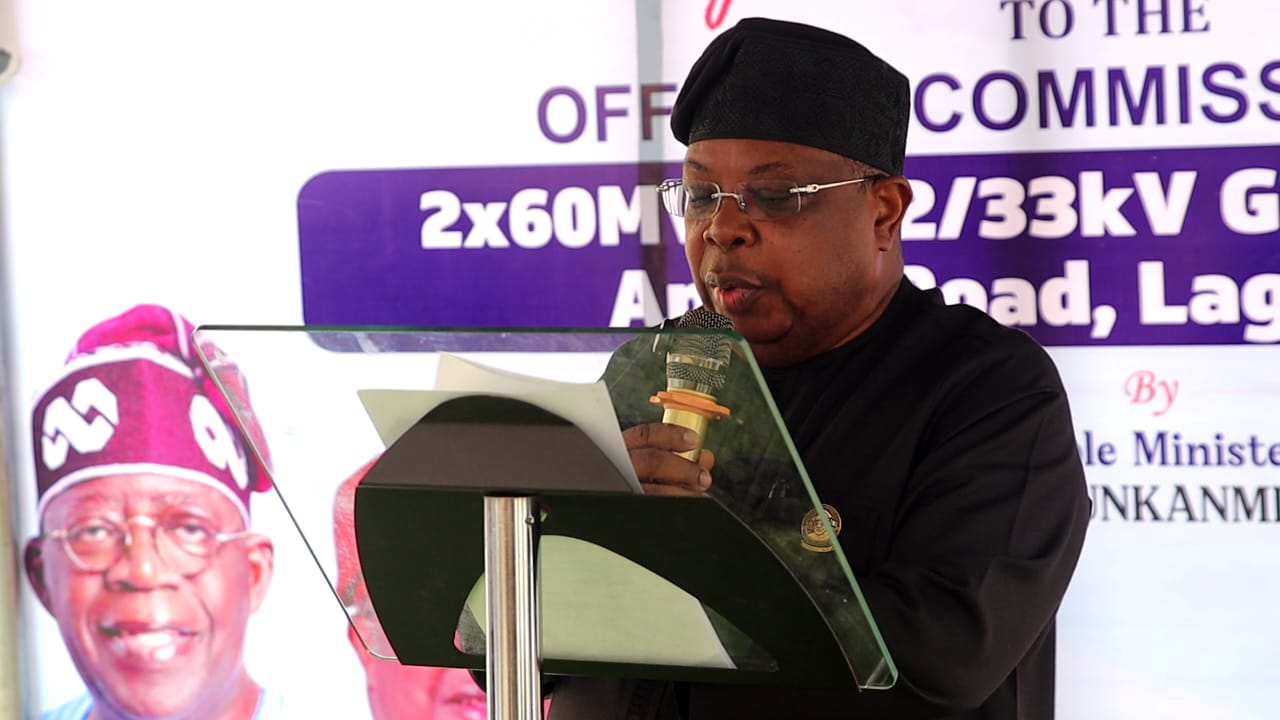
At the Apapa Road 132/33kV Transmission Substation, TCN Managing Director and Chief Executive Officer Sule Ahmed Abdulaziz said the installation and energisation of two new 60MVA transformers had tripled the substation’s capacity from 60MVA to 180MVA.
The Apapa Road upgrade is designed to increase the volume of bulk power available for EKEDC to distribute to customers in Apapa Causeway, Ijora, Amukoko, Ajegunle, Apapa Wharf, Tin Can Island and other critical commercial areas.
Abdulaziz said the project had already contributed to improved supply quality and would support economic productivity in Lagos and across Nigeria.
The Apapa Road project was sponsored by the Japan International Cooperation Agency (JICA) in partnership with TCN. It was delivered by Takaoka Engineering Co. Ltd. under Emergency Rehabilitation and Reinforcement of Lagos Transmission Substations project.
The grant agreement between the Federal Government and JICA was signed on 23 November 2018, while implementation began in 2019 following preparatory surveys and grant mobilisation by Yachiyo Engineering Co. Ltd.
Abdulaziz described the project as evidence of the government’s commitment to expanding and strengthening the national transmission network, reducing technical losses
and improving national-grid stability.
He appealed for similar grant support for other critical sections of the transmission system so that TCN could sustain and optimise operations nationwide.
Together, the Ijora and Apapa Road interventions represent a significant reinforcement of transmission infrastructure in Lagos, Nigeria’s principal commercial and industrial hub.
Their combined effect is an additional 260MVA of installed substation capacity, although the two projects remain distinct upgrades at separate facilities.
The commissioning comes as the Federal Government seeks to use improved electricity infrastructure to support its ambition of transforming Nigeria into a one-trillion-dollar economy.
For Lagos businesses and communities connected to the affected network, the
immediate expectation is more available bulk power, fewer transmission bottlenecks and a stronger platform for commercial and industrial activity.