

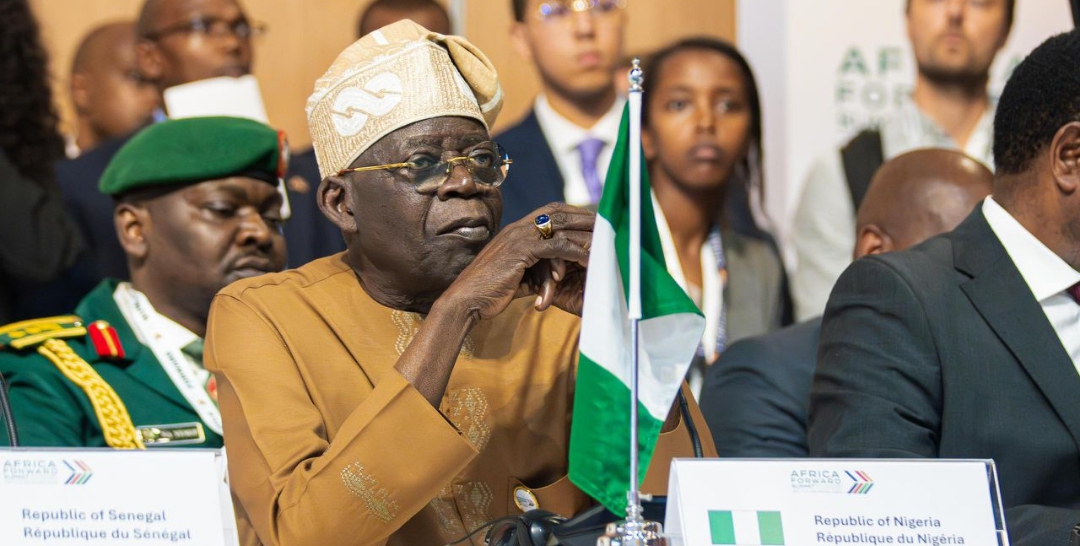
President Bola Ahmed Tinubu of Nigeria has called for a significant reform of the global financial architecture to foster Africa’s economic growth and prosperity.
Speaking at the Africa Forward Summit in Nairobi, Kenya, Tinubu emphasized the urgent need for the equitable financial systems that support industrialization and prevent the de-industrialization of African nations.
Nigerian leader led a delegation to the summit, co-hosted by the Presidents Emmanuel Macron of France and William Ruto of Kenya, which convened leaders and officials from over 30 African countries.

The discussions centered on stronger economic integration and addressing critical challenges facing the continent.
Reforming the Global Financial System
Highlighting Nigeria’s stance, Tinubu asserted that the current international financial architecture is an “instrument of industrial disarmament for Africa.”
He pointed out that despite decades
of independence, Africa’s share of global manufacturing value added remains below 2 percent, largely due to a financial system that starves industries of affordable capital and tolerates illicit financial flows. Tinubu underscored the paradox where African nations export raw materials but import processed goods at a premium while argued that high cost of borrowing in Africa, often five to ten times higher than in developed nations, hinders industrial growth and the ability
to compete globally.
“Every single dollar that leaves our treasury to pay punitive interest rates is a dollar that did not go into our steel sector, our textile mills, our agro-processing plants, or our digital industries,” he stated.
Nigeria, he noted, has undertaken significant domestic reforms, including removing fuel subsidies, unifying exchange rates, and recapitalizing its banking system.  These actions, sovereign choices rather than external conditions, have led to a declining debt-to-GDP ratio and stronger external reserves. Yet, even a reforming nation like Nigeria faces deindustrialization due to the existing financial system.
The Blue Economy: A Cornerstone for Development
Tinubu also highlighted Nigeria’s vast potential in the blue economy, which he
described as a cornerstone for Africa’s development.
He committed Nigeria to intensifying
regional coordination by offering its Deep Blue Project’s maritime intelligence infrastructure as a shared data hub for Gulf of Guinea states. He stressed that secure sea lanes, predictable regulation, and functional courts are essential to attract private capital and unlock the blue economy’s potential.
“Maritime sovereignty does not repel investment — it attracts it,” Tinubu affirmed, inviting partners to collaborate on climate-aligned port modernization and the digital transformation of Nigeria’s maritime sector.
He emphasized that maritime sovereignty and ocean governance are non-negotiable foundations for Africa’s blue economy transformation.Addressing Migration and Ensuring Peace and Security
On the issue of migration, President Tinubu called for addressing root causes in countries of origin, such as lack of jobs, security, and hope.
He urged international partners to move
beyond rhetoric and invest in climate adaptation, energy access, digital skills, and productive sectors that employ young people, thereby making staying at home a genuine choice.
He also advocated for a global migration governance architecture that is fit for purpose, supporting the African Union’s Migration Policy Framework and the Khartoum Process, but calling for a more coherent link between regional efforts and global institutions.Regarding peace and security, President Tinubu urged African countries to work together, emphasizing that collective effort is crucial for stability and progress across the continent.
High-Level Engagements and Business Participation
During the summit, President Tinubu held bilateral meetings with Madagascar’s
President, Michael Randrianirina, and the President of the Confederation of African Football, Dr. Patrice Motsepe, expressing Nigeria’s readiness to host the 2026 CAF awards.
The Nigerian delegation included several ministers, such as Minister of Foreign Affairs, Bianca Odumegwu- Ojukwu, and the Minister of Finance and Coordinating Minister of the Economy, Taiwo Oyedele, among others.
Prominent business leaders, including Aliko Dangote, Abdulsamad Rabiu, Tony Elumelu, and Aigboje Aig-Imoukhuede, also attended, participating in discussions on entrepreneurship, AI, investment opportunities, and industrialization.