

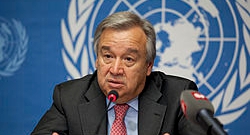
Conflict is turning food into a weapon, driving millions from their fields, disrupting vital trade routes and pushing vulnerable communities toward famine, United Nations Secretary-General António Guterres warned the Security Council on 25 August.
Speaking during an urgent discussion on conflict and food security, Guterres said attacks on farms, markets, water systems and transport networks were destroying the foundations of civilian survival.
“Critical food systems — and the lives and livelihoods they sustain — are under attack,” he said. The warning comes as armed conflict reaches its highest level since the Second World War.
In 2025, at least 266 million people faced acute food insecurity, while famine was confirmed simultaneously in Sudan and Gaza for the first time this century—a development the Secretary-General called “a shameful milestone.”
From the Sahel to Haiti, violence is cutting people off from food and livelihoods. Farmers are being driven from their land, markets are being struck, and entire communities are being isolated.
In Sudan, drone and missile attacks have hit marketplaces, while gang violence in Haiti has severed access to whole communities. Humanitarian workers attempting to deliver aid in Gaza, Mali, Myanmar and Sudan have faced obstruction, attack and death.
The crisis does not stop at national borders. The war in Ukraine continues to affect grain and energy exports around the Black Sea, while instability in the Middle East threatens shipping, fertilizer supplies and the cost of farming worldwide.
Restrictions and closures have sent commodity prices higher, with import-dependent countries—many already burdened by heavy debt—bearing the greatest risk.
Guterres urged the Security Council to enforce Resolution 2417, which recognizes the link between armed conflict, food insecurity and famine.
He called on combatants to stop destroying food, crops, livestock and drinking-water supplies, and to protect farms, mills, storage facilities, ports, markets and transportation routes.
He also demanded safe, unimpeded access for humanitarian personnel and urged governments to act before famine is formally declared.
“We cannot wait for famine or catastrophic conditions to be formally confirmed,” he said. “I call on this Council to act when the warning lights are flashing.”
The Secretary-General backed a proposed, time-bound confidence- building mechanism focused initially on fertilizers and related raw materials amid the Strait of Hormuz crisis.
But he stressed that such an initiative could not replace the full restoration of navigational rights and freedoms in the Strait of Hormuz and the Bab al-Mandab Strait.
The message to the Council was clear: hunger is not an unavoidable by-product of war. It is often the predictable result of attacks on the systems that feed people—and ending it will require political will, accountability and the protection of civilians before the warning lights become flames.