

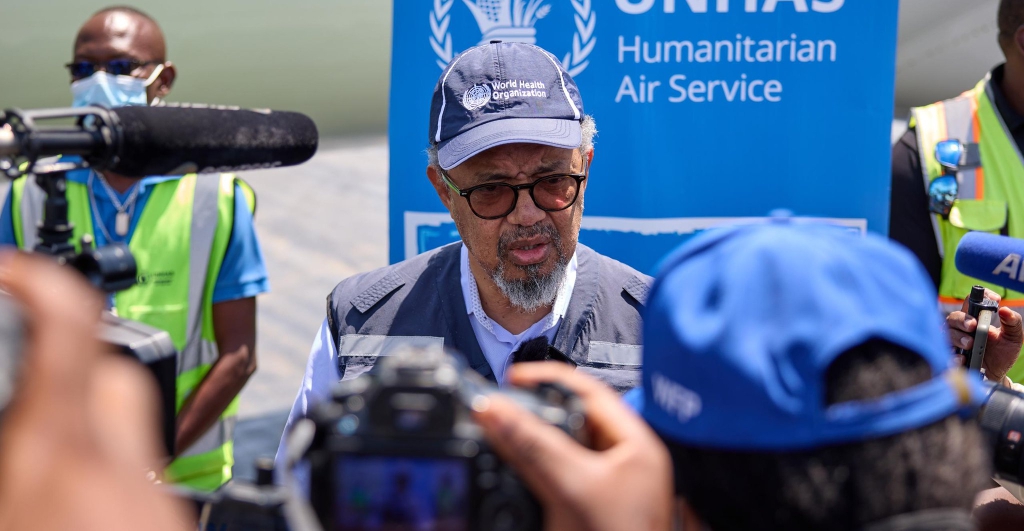
The Ebola epidemic in the Democratic Republic of the Congo has surpassed 6,000 reported cases and 3,000 deaths, becoming the second-largest outbreak on record and the fastest moving outbreak the World Health Organization has ever seen, WHO Director-General Tedros Adhanom Ghebreyesus said.
Speaking to Geneva-based journalists at WHO headquarters on Wednesday, Tedros warned that the outbreak is spreading across 60 health zones in six provinces and continues to threaten neighbouring countries and the wider region.
Ituri province remains the epicentre,
accounting for 85% of reported cases and 88% of deaths, according to the briefing.
Community deaths fuel transmission
The WHO’s most urgent concern is that most deaths are occurring in communities rather than in Ebola treatment centres.
Many victims are not being buried safely, increasing the risk of further transmission, while a significant number of deaths involve people who were
not identified as known contacts of confirmed cases.
That pattern suggests that health authorities have yet to identify all of the chains of transmission, Tedros said. Until those chains are found and broken, the epidemic is likely to continue spreading.
“Until every chain is found and broken, the epidemic will continue,” Tedros said,
warning that the outbreak remains a threat to the DRC, its neighbours and the region as a whole.
The response is unfolding in a region already battered by conflict, displacement, poverty and hunger.
Tedros said the humanitarian crisis has contributed to public mistrust,
complicating efforts to persuade people to report illnesses, accept treatment and cooperate with contact-tracing and safe-burial measures.
During a visit to the affected area, one community leader questioned why international attention focused on Ebola while diarrhoeal diseases, malaria, malnutrition and conflict continued to take lives.
Tedros described the question as fair and said restoring community trust and ownership was the single most important factor in changing the epidemic’s trajectory.
Response capacity expands WHO said it is coordinating with the Congolese govt, Africa Centres for Disease Control and Prevention and other partners to expand the response. The agency has shipped more than 330 tonnes of emergency supplies and deployed more than 300 experts.
Laboratory capacity has grown from a single national reference laboratory to a network of 24 laboratories located closer to affected communities.
Testing capacity has reached 3,000
tests per day, while isolation and treatment capacity has increased to more than 1,300 beds across 49 facilities. WHO plans to triple that capacity to 3,000 beds within the next three months.
Researchers are also accelerating trials of vaccines and treatments. The PARTNERS trial has enrolled more than 300 Ebola patients to assess two treatments.
A separate study is testing the antiviral obeldesivir among high-risk contacts to determine whether it can prevent
illness after exposure. Two vaccines against Bundibugyo virus are undergoing safety trials in the United Kingdom and Canada.
WHO said an already approved vaccine against Zaire ebolavirus—the species
responsible for most previous Ebola outbreaks—may not protect against Bundibugyo virus.
The agency has issued emergency guidance on using the existing vaccine during Bundibugyo outbreaks and is working with partners to move three vaccine candidates into efficacy trials in the DRC, beginning in October or November.
Gaza faces worsening public-health risks
Tedros also used the briefing to highlight a deepening humanitarian and public- health emergency in Gaza as winter approaches.
Most people remain displaced in overcrowded tented camps, where overflowing sewage, accumulating waste and restricted access to safe water are creating increasingly dangerous conditions.
WHO said water contamination is rising and that cases of acute watery diarrhoea have nearly doubled this year. With the onset of seasonal rains, flooding could carry sewage and contaminated water through densely populated areas, increasing the risk of disease outbreaks.
Gaza’s already overwhelmed health system is not equipped to manage such a surge, the agency said.
WHO is supporting disease surveillance and preparedness but said access to essential laboratory and diagnostic supplies remains restricted.
The organization called for the unimpeded and expedited entry of medicines, rehabilitation equipment and public-health supplies at the scale needed to meet the needs of Palestinians in Gaza.
More than 6,600 people in Gaza now require long-term rehabilitation and prosthetic or orthotic services after limb amputations.
Although some wheelchairs and crutches have entered the territory, WHO said prosthetic and rehabilitation equipment has been prevented from entering for more than two years. As a result, only a small proportion of people who have lost limbs have received prosthetic devices.
The agency also said that thousands of people require medical treatment unavailable in Gaza. On Monday, WHO supported the evacuation of five children to Romania and Belgium, accompanied by 14 relatives or carers.
It renewed its call for patient referrals to health facilities in the West Bank, including East Jerusalem, to be reopened.
A crisis defined by access and trust
The two emergencies described by WHO differ in geography and disease, but both are being intensified by barriers to care, fragile health systems and humanitarian conditions that make prevention and treatment more difficult.
In the DRC, hidden transmission and unsafe burials are sustaining Ebola’s spread. In Gaza, displacement, damaged infrastructure and restricted supplies are increasing the risk of waterborne disease while limiting access to essential rehabilitation and specialist care.
For the Ebola response, WHO’s warning is that expanded beds, laboratories and clinical trials will not be sufficient unless health workers can reach communities and residents trust the response.
In Gaza, the agency’s appeal centres on access: to clean water, sanitation, diagnostics, medicines, rehabilitation equipment and evacuation routes.