

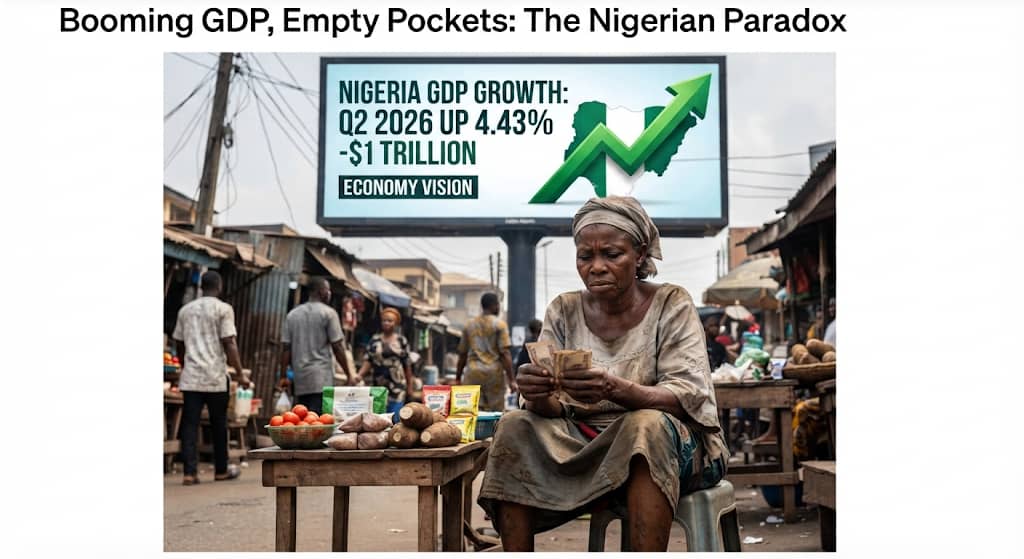
Nigeria’s economy expanded faster in the second quarter of 2026, according to the Federal Ministry of Finance, but the upbeat figures arrive against a difficult reality for millions of households still struggling with high food prices, weak purchasing power and the rising cost of daily life.
The ministry said real Gross Domestic Product grew by 4.43 per cent year-on -year in Q2 2026, up from 4.23 per cent in the same quarter of 2025 and 3.89 per cent in the first quarter of this year.
Growth in the first half of 2026 consequently rose to 4.16 per cent,
compared with 3.68 per cent in the corresponding period of 2025.
The government described the figures as evidence that its economic reforms are beginning to produce a broader and more durable recovery. It said 27 economic subsectors recorded real growth above 3 per cent during the quarter, compared with 23 subsectors a year earlier.
Productive sectors drive expansion
Manufacturing growth more than doubled to 3.24 per cent from 1.60 per cent in Q2 2025. Agriculture also accelerated to 4.39 per cent from 2.82 per cent, while services, the country’s largest economic segment, expanded by 4.60 per cent compared with 3.94 per cent a year earlier.
The ministry also pointed to relative exchange-rate stability and a more than 12 per cent appreciation of the naira between the first halves of 2025 and 2026. It said this contributed to an estimated 17 per cent expansion of the economy in U.S. dollar terms during the period.
On the strength of the performance, the ministry said Nigeria is positioned to consolidate its place among Africa’s largest economies and move closer to the government’s ambition of reaching a $1 trillion economy by 2030.
It added that continued macroeconomic stability and improved investor confidence could help Nigeria become
Africa’s largest economy by 2028.
Growth figures face a cost-of-living test
For ordinary Nigerians, however, the significance of the expansion will be measured less by GDP rankings than by whether incomes can buy more food, transport, housing, healthcare and education.
Economic growth does not automatically translate into improved living standards. GDP measures the value of goods and services produced in an economy, but it does not show how gains are distributed among households, whether wages are keeping pace with prices, or how many people have secure and adequately paid jobs.
A rise in output can therefore coexist with widespread hardship, particularly when inflation, job insecurity and higher
production costs erode the real value of earnings. Many families continue to face difficult choices over essential spending.
Consumers whose wages have remained largely unchanged may not feel the benefit of stronger services or improved industrial output if the prices of staple foods, rent, electricity, fuel, school fees and medicines continue to absorb most of their monthly income.
Small businesses, meanwhile, may experience increased activity without seeing meaningful improvements in
profit margins when energy, logistics, credit and raw-material costs remain elevated.
The ministry said the naira’s appreciation and government social programmes could strengthen dollar incomes, improve purchasing power and lift millions of Nigerians out of poverty.
That claim will depend on how quickly exchange-rate gains are reflected in
domestic prices, whether social assistance reaches intended beneficiaries, and whether growth creates productive employment rather than remaining concentrated in sectors with limited income distribution.
Reforms must deliver household relief
The latest figures offer the government an important opportunity to demonstrate that its reforms can move beyond macroeconomic stabilization and produce tangible improvements in household welfare.
Sustained growth in agriculture and manufacturing could help lower dependence on imported goods, strengthen local supply chains and
create jobs.
A more predictable exchange rate could also help businesses plan, provided
that foreign-exchange liquidity and access to affordable credit improve alongside it. But the recovery remains vulnerable if its benefits fail to reach the majority of citizens.
Policymakers will need to track not only headline GDP but also real wages, food
affordability, employment quality, electricity supply, business survival and poverty levels.
These indicators will determine whether Nigeria’s economic acceleration is broad-based in practice or mainly visible in national accounts.
The ministry said the results underscore the need to maintain policy consistency as the benefits of reform begin to reach households.
For Nigerians facing daily economic pressure, that remains the central test: whether higher growth will eventually translate into cheaper essentials, better jobs, stronger incomes and a greater ability to meet basic needs.
Until that happens, the government’s growth narrative and the public’s experience of hardship are likely to continue existing side by side—one reflected in quarterly statistics, the other in the choices families make every day.