

Cameroon’s first Women’s Africa Cup of Nations title was built on a combination of controlled group-stage football, defensive discipline and increasingly fearless performances against the continent’s traditional powers.
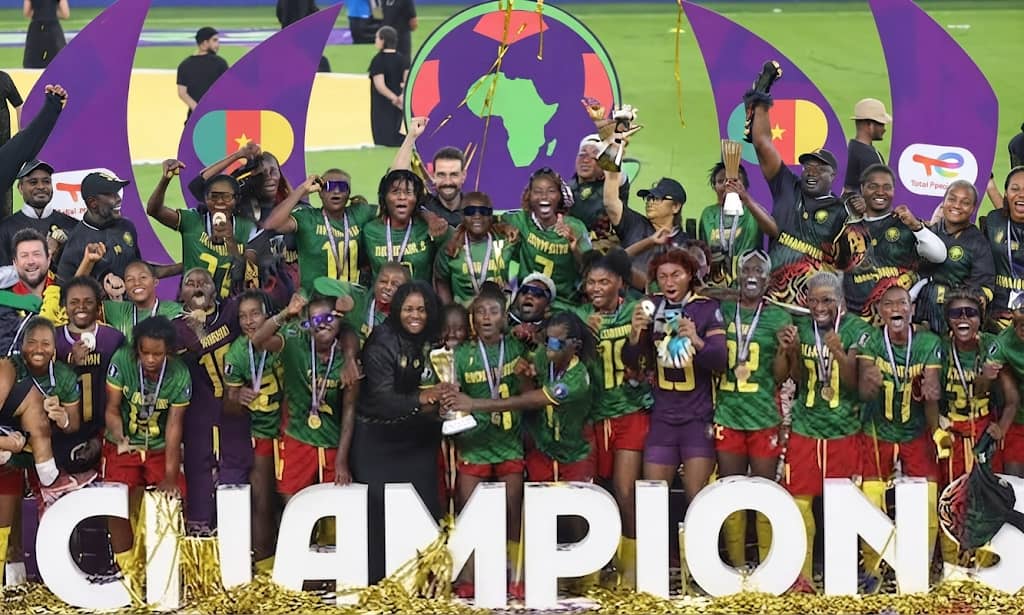
The Indomitable Lionesses completed that journey on Aug. 16 with a 3–0 victory over Malawi in the final in Rabat.
Marie Ngah scored twice and Naomi Ndjoah Eto added another goal as Cameroon produced a decisive first-half performance to turn years of continental frustration into the country’s first WAFCON crown.
The triumph prompted congratulations from African Union Commission Chairperson Mahmoud Ali Youssouf, who described the achievement as a proud moment for Cameroon and a reflection of the growing strength of women’s football across Africa.
A confident start in Group D
Cameroon entered a newly expanded tournament featuring 16 teams, four more than in the previous 12-team format.
The competition was played in Morocco from July 26 to Aug. 16, with the four semifinalists also securing automatic qualification for the 2027 FIFA Women’s World Cup.
Placed in Group D alongside Ghana, Mali and debutants Cabo Verde, Cameroon made an immediate statement by defeating Mali 2–1 in its opening match.
The result established the Lionesses as early contenders in a group that quickly became one of the tournament’s most competitive.
They followed that victory with a narrow 1–0 win over Ghana. It was another disciplined performance, giving Cameroon six points from its first two matches and putting the team in a strong position to reach the knockout stage.
The group campaign ended with a 1–1 draw against Cabo Verde. Cameroon did not finish with a perfect record, but its unbeaten run was enough to secure first place in Group D with seven points. Ghana advanced in second place, while Mali and Cabo Verde were eliminated.
Cameroon opened its campaign with a 2–1 victory over Mali before defeating Ghana 1–0 in its second Group D match.
The Lionesses completed the group stage with a 1–1 draw against Cabo Verde, finishing top of the group with seven points and remaining unbeaten.
In the quarter-finals, Cameroon eliminated defending champions Nigeria with a 1–0 win. The team then edged hosts Morocco 3–1 on penalties after a goalless semifinal that lasted 120 minutes.
In the final, Cameroon defeated Malawi 3–0 to claim the first WAFCON title in the country’s history.
The turning point: defeating Nigeria
The quarter-final against Nigeria represented the first major test of Cameroon’s championship credentials. Nigeria arrived as the defending champion and a 10-time winner of the competition, while Cameroon had spent much of its WAFCON history in the shadow of the continent’s most successful women’s team.
That hierarchy was overturned in Casablanca. Cameroon began the match aggressively and controlled much of the opening half. In the 19th minute, Nyadjou struck from a free-kick to give the Lionesses a 1–0 lead.
Nigeria responded with greater urgency after the interval, creating several opportunities as it searched for an equalizer.
Cameroon’s goalkeeper Michaely repeatedly denied the Super Falcons, helping her team protect its narrow advantage until the final whistle.
The result was more than a place in the semifinals. It was a psychological breakthrough.
Cameroon had not simply advanced; it had removed the defending champions from the tournament and demonstrated that its defensive structure could withstand sustained pressure from one of Africa’s most accomplished sides.
The win also guaranteed Cameroon a place at the 2027 World Cup. That qualification added another layer of importance to a campaign already becoming historic.
Cameroon’s ambition, however, was no longer limited to reaching the global tournament. The team had a continental title within sight.
Nerves, resilience and a penalty shootout
The semifinal against hosts Morocco became the most demanding match of Cameroon’s run. Played at the Moulay El Hassan Stadium in Rabat, the contest remained goalless through 120 minutes, with neither side able to break the deadlock.
Morocco appeared to have a late opportunity to seize control when it was awarded a penalty in the 118th minute. Fatima Tagnaout stepped forward, but her effort was not converted. The miss kept Cameroon alive and sent the semifinal to a shootout.
Cameroon handled the pressure with composure. Marie Ngah, Rose Bella and Myriam Nyadjou converted their penalties, while Morocco managed only one successful attempt through Hanane Aït El Haj. The hosts missed three of their four kicks, allowing Cameroon to win the shootout 3–1.
The victory sent Cameroon into its fourth WAFCON final. It also ended Morocco’s hopes of reaching a third consecutive final and underscored the Lionesses’ ability to survive not only open play but also the emotional strain of a high-stakes knockout match.
A final won before halftime
If the semifinal was a test of patience, the final was a display of attacking efficiency. Malawi, appearing at the WAFCON for the first time, had already captured attention by reaching the championship match. Like Cameroon, the debutants were seeking their first African title.
Cameroon settled the contest with a devastating first-half spell. Ngah opened the scoring in the 20th minute. Ten minutes later, Ndjoah Eto doubled the advantage after being set up by Myriam Nyadjou.
Ngah then struck again three minutes into stoppage time, this time assisted by Ndjoah Eto. The 3–0 scoreline effectively decided the final before the interval and gave Cameroon the platform to manage the second half without surrendering its control.
The margin also reflected the broader pattern of the Lionesses’ knockout campaign. Cameroon had conceded only twice before the final, according to CAF, and combined that defensive resilience with the kind of clinical finishing that had sometimes eluded the team in previous tournaments.
A title with wider meaning
Cameroon’s victory carries significance beyond the trophy. It ends the country’s long wait for a first WAFCON title, confirms the emergence of a new continental power and gives the national team momentum heading into the 2027 World Cup cycle.
For the African Union, the triumph is also part of a larger story about the development of women’s football.
Youssouf praised the Lionesses’ talent, determination, resilience and team spirit, while highlighting their potential to inspire girls and women across the continent.
That message reflects the nature of Cameroon’s campaign. The title was not won through a single spectacular performance, but through progression: an unbeaten group stage, a disciplined victory over Nigeria, a nerve-shredding semifinal against Morocco and a commanding final against Malawi.
By the time the confetti fell in Rabat, Cameroon had moved from hopeful contender to champion. The Indomitable Lionesses had finally converted their promise into history.