

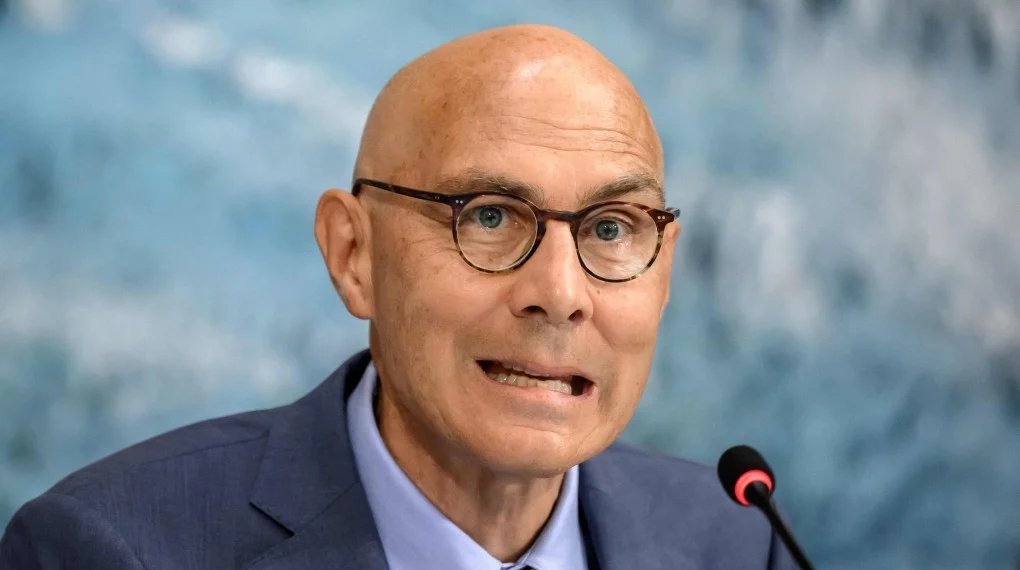
UN High Commissioner for Human Rights Volker Türk warned the Human Rights Council on Monday over a surge in armed conflicts, repression, climate disruption, economic inequality.
Adding that unchecked technological power is pushing the international system into an increasingly dangerous period — but said the crisis is not inevitable and can be confronted through human rights, accountability and renewed diplomacy.
Opening the 63rd session of the Council, Türk described the world as living in an “age of extremes”, marked by “raging wars, painful polarization, climate chaos, and headspinning technological change”.
He rejected the idea that these trends are unavoidable, arguing that people have repeatedly organized to resist oppression, expose injustice and demand their rights.
“There is only one way out of this madness: peace negotiations that respect the UN Charter,” Türk said, referring to the expanding number of conflicts around the world.
Conflicts entering “dangerous territory”
Türk said there are now more than 60 wars involving at least one state — the highest number since the end of the Second World War — and warned that the rise in interstate conflict was taking the world into “particularly dangerous territory”.
He called for an immediate return to negotiations between the United States and Iran, saying renewed attacks were affecting the entire Gulf region.
He expressed particular concern over reports of civilian deaths and injuries, including at a wedding in Iran’s Hormozgan province, and warned that the crisis was generating wider geopolitical and economic consequences.
On Ukraine, Türk said Russia’s full-scale invasion had entered its fifth year on a
“menacing trajectory”, with rising civilian casualties and intensified attacks on energy infrastructure.
He said most civilians killed were Ukrainians, while also noting reports of
increasing deaths and injuries in Russia.
He condemned reports that fully autonomous drones launched by Russia had killed three Ukrainians the previous month. Ukraine had reportedly also field-tested such weapons, he said.
Türk joined calls for an urgent ban on weapons capable of taking human life without human involvement. He also urged an immediate ceasefire in Sudan, where he said the war was expanding into its fourth year.
Attacks on markets, hospitals, fuel stations and other civilian infrastructure continued, with civilians at imminent risk in Kordofan, Blue Nile, and North and West Darfur.

Türk called for foreign involvement to end and for a return to inclusive civilian rule.
In Gaza, Türk cited figures from the Palestinian Ministry of Health saying that Israel had killed more than 1,300 Palestinians in daily strikes despite a ceasefire announced almost a year earlier.
He accused Israel of continuing to restrict humanitarian aid and condemned proposals for the forced expulsion of Palestinians from the Gaza Strip, as well as dehumanizing rhetoric by senior officials.
At the same time, he said armed groups affiliated with Hamas had executed and tortured Palestinians suspected of collaboration.
In the West Bank, he said Israeli annexation was advancing despite a clear ruling by the International Court of Justice, urged states to stop transferring arms that could be used to violate international law.
He also called on companies to end business practices supporting illegal settlements. Türk said Israeli forces must end attacks on civilians and civilian infrastructure in Lebanon.
His office was investigating alleged violations by both Israel and Hezbollah since 2 March, he said, describing the work as essential to truth, accountability and future reconciliation.
The High Commissioner also highlighted renewed hostilities in South Sudan, escalating tensions in Yemen and violence affecting civilians in Ethiopia’s Amhara and Oromia regions and in Tigray.
He again demanded the release of 73 UN and NGO staff members detained by the Houthis in Yemen.
A call for accountability and inclusive peace
Türk outlined seven priorities for the coming years: investigating the commercial and economic interests that fuel wars; supporting victim-centred transitional justice; strengthening mediation and confidence-building; increasing women’s participation in peace negotiations; working with grassroots peace movements; using human rights monitoring as an early-warning mechanism; and pressing for accountability.
He urged states to reinforce domestic justice systems, support the International Criminal Court and use universal jurisdiction where national courts are unable or unwilling to prosecute alleged atrocity crimes.
Women remain largely absent from negotiations over conflicts including those in the Democratic Republic of the Congo, Gaza, Sudan and Ukraine, despite their historic contributions to peace- building in countries such as Ireland, Liberia and the Philippines, Türk said.
AI safety: “before it is too late”
The High Commissioner made artificial intelligence a central part of his warning, saying the technology’s rapid development was outpacing effective governance.
A small number of powerful individuals and companies wielded enormous influence over AI, while public debate about “freedom” often masked the exploitation of personal data, he said.
Türk welcomed recent international initiatives, including the Global Dialogue on AI and the Independent International Scientific Panel on AI, as well as measures by the European Commission on platform accountability and by South Korea on AI governance.
But he said he shared concerns from industry insiders that advanced AI could pose an existential risk to humanity. “AI that escapes its testing environment, or blackmails developers to prevent itself from being turned off, is AI that is too powerful,” he said.
He called for an “all-out effort” to establish binding safety and security guarantees before it was too late.
Türk said he would write to AI companies urging them to reduce risks within their control and called for countries hosting AI systems or supplying their components to agree on red lines.
He also demanded independent verification, stronger security cooperation within the industry and assessments of AI’s effect on employment, democracy and the environment.
Governments and companies, he said, should listen to people who are rejecting or refusing to use AI because of these concerns.
Climate and inequality deepen pressure
Türk linked the climate emergency to human rights, warning that technological progress could not compensate for the destruction of the planet.
He cited an International Monetary Fund estimate that the hidden costs of fossil fuels — including damage to health,
economies and the environment -amount to about $6.7 trillion a year, or nearly 6% of global GDP.
He said European heatwaves had killed an estimated 35,000 people during the summer, though the true figure was likely higher, and urged governments to keep global warming as close as possible to the Paris Agreement’s 1.5°C target.
Rapid decarbonization, investment in resilience and adaptation, and stronger early-warning systems were human rights imperatives, he said.
The High Commissioner said extreme concentrations of wealth and power were undermining social stability and sustainability.
Tariffs imposed on countries already burdened by climate shocks, debt and unequal tax rules were weakening their political autonomy and ability to fight poverty.
With fewer than four years remaining to deliver the UN 2030 Agenda, only 36% of its targets were progressing and 15% had moved backwards, Türk said.
Growing numbers of people could not afford secure housing or a healthy diet, while economic growth had benefited owners and investors more than workers in many countries.
He pointed to public anger in Albania, Argentina, India, Indonesia and Tunisia over inequality, high living costs, unemployment, corruption and poor public services.
A “human rights economy”, he argued, would require fair taxation, transparent
institutions, effective public spending and policies that distribute opportunity more evenly.
Repression and shrinking civic space
Türk accused governments in several regions of responding to social frustration with repression rather than dialogue.
In Iran, he said authorities were using war as a pretext for intensified oppression and reported that 59 people had been executed on national-security charges since March 2026 — more than the number executed on such charges during all of 2025.
He also criticized business closures linked to compulsory hijab rules. He accused Pakistan’s authorities of using excessive lethal force and arbitrary detention against protesters, while praising dialogue with youth leaders as the appropriate response to recent protests in India.
He condemned the closure of opposition parties in Nicaragua and continued suppression of opposition groups in Russia.
Restrictions on civic space and media freedom were worsening in countries including Azerbaijan, Georgia, Russia, Tunisia and Uganda, he said.
Türk also deplored a ban on demonstrations in Afghanistan and warned that digital surveillance was becoming a more powerful instrument of repression in Angola, Myanmar and Serbia.
He called for the release of all arbitrarily detained people in Venezuela and immediate access to detention sites for his team.
Ahead of elections in Bosnia, he urged political leaders to combat hate speech and discrimination and stop glorifying war criminals.
Discrimination, migration and gender- based violence
Türk warned of a worldwide rise in systemic discrimination. Femicide remained an alarming trend, he said, citing reports that seven women had recently been killed by current or former partners in Italy and nine in Cameroon.
He stressed that poor data made the scale of the crime difficult to measure, while legislation and prosecution needed to be paired with action against discrimination, inequality and gender stereotypes.
He again called on Afghanistan’s de facto authorities to repeal policies that effectively.exclude women and girls from public life, describing the system as “gender-based apartheid”.
He also raised concerns over arrests under discriminatory laws in Burkina Faso, Niger and Senegal, and restrictions affecting the equal rights of transgender people in several countries.
Racism and anti-migrant rhetoric were also contributing to violence, Türk said.
He accused politicians and media platforms of portraying migrants, refugees, Muslims, racial and ethnic minorities as collective threats, sometimes triggering attacks on entire communities.
He urged the United States not to return people to places where they could face irreparable harm, including Haiti, and called for due process in removals to third countries.
Four additional people had died in US immigration custody since his previous update, bringing the total reported deaths in 2026 to 23, he said.
Türk also expressed concern that plans to equip immigration agents with electric-shock gloves could increase violence during operations.
He criticized restrictions on the rights and religious freedom of Tibetans in China and said his office remained deeply concerned about conditions in Xinjiang, including in detention facilities and allegations of torture.
A new global human rights alliance
Despite the deteriorating situation, Türk said civil society groups were demonstrating that people could still shape events by documenting abuses, lobbying lawmakers, protesting peacefully and building solidarity networks.
He cited pressure from South African civil society as a factor in gender-based violence and femicide being declared a national disaster in November 2025.
He announced that the Global Alliance for Human Rights would serve as a platform for governments, civil society, philanthropies, businesses, academics, young people, artists and local authorities to develop joint responses to human rights challenges.
In its initial phase, the alliance will seek to bring human rights education into every classroom, promote technology and business practices that serve people, and help cities deliver better services to residents.
Türk also pledged to broaden engagement with Indigenous peoples, people of African descent, LGBTIQ+ communities, religious minorities, stateless and undocumented people, homeless people, migrants and refugees.
The initiative comes as the UN human rights system faces chronic underfunding and a wider liquidity crisis.
Türk called for support for the UN treaty-body system and said he would propose reforms and new approaches over the next four years as part of the UN80 process.
Concluding his address, Türk defended multilateral cooperation and equal standards for accountability, warning that some powers were seeking to replace international cooperation with transactional deal-making.
He said weakening cooperation on health, climate and other global issues had already worsened cross-border threats, including the Ebola outbreak in the Democratic Republic of the Congo.
Human rights, he said, remained both a moral commitment and a practical tool for navigating a turbulent world. “Human rights are carriers of hope,” Türk told the Council. “They’re compass in turbulent times, and they offer concrete solutions to our challenges.”